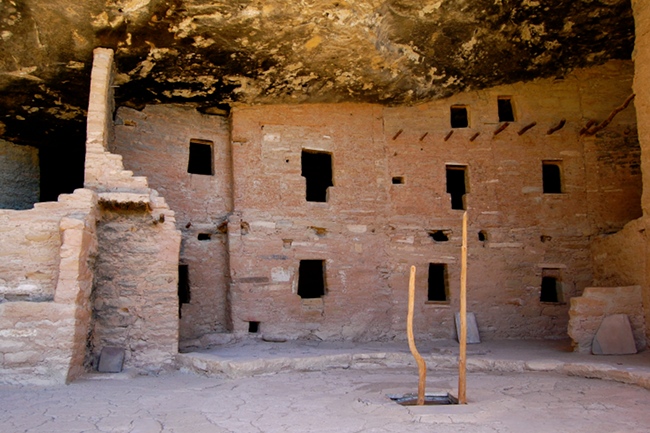
Mesa Verde National Park, CO
This is a continuation of our Summer ’08 Road Trip. The majority of June 13th was spent traveling from Chaco Culture National Historic Park in New Mexico to Buckskin Gulch on the Arizona/Utah border. To break the monotony of interstate travel, we planned to stop in the southwest corner of Colorado to tour Mesa Verde National Park and the Four Corners area.
Mesa Verde is very similar to Chaco Culture in that visitors walk through and observe Ancestral Puebloan ruins. The main difference is that Mesa Verde is much more accessible, therefore the crowds are much larger. Still, the park offered an amazing display of ancient ruins presented by outstanding park rangers. I can’t overstate this – a good park ranger can enhance a national park experience like nothing else.


 At Mesa Verde we took two guided tours: Balcony House and Cliff Palace. Balcony House was as fun as it was interesting (included steep stairs, traditional ladders, and awesome sites). Angela and I decided that the tour guide was pretty much Mr. Rogers, had he become a park ranger. He even had a sweater with pads near the elbows. If he would have changed his shoes before the tour, I think I would have asked for an autograph, but all I got was a photo. There was even a pictograph at the end (pictographs are painted – petroglyphs are carved).

This is a mesa, defined by the Oxford American Dictionary as, “An isolated flat-top hill with steep sides.” In Mesa Verde, which translates literally to mean “green table”, these “steep sides” were carved into cliff-side dwellings by Ancestral Puebloans from A.D. 600 to A.D. 1300. According to the park’s website, Mesa Verde includes, “over 4,000 known archeological sites, including 600 cliff dwellings… some of the most notable and best preserved in the United States.”

Ranger discusses Ancestral Puebloan means of gathering water. It hadn’t rained for days, but notice the damp spot in the lower left hand corner. These cliffs store and slowly disperse rainwater over long periods of time.


Looking down into a kiva, which is a room reserved by the Ancestral Puebloans for religious ceremonies. Thousands of years ago, natives would seal the top of kivas with a ceiling made from long crossed logs and adobe. All that was left to indicate the location of the kiva was a ladder leading down into a hole. On the floor of the kiva, you can see a small hole. This is called the Sipapu, a Hopi word for “place of emergence.” The Hopi believed that their descendants came from the Earth, and the Sipapu is a portal to that world.


climbing out of Balcony House


* * *
 The Cliff Palace tour was equally interesting. This location is one of the larger dwellings in Mesa Verde, yet it is believed that most of the space was used for storage and possibly a market, not living space. We purchased our 1-hour tour tickets at the visitor center and hustled down the red dirt road to the trailhead.


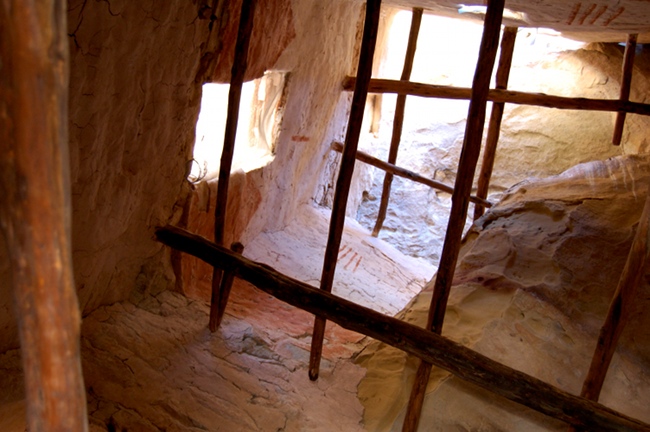
At this tower, we were instructed to look into a window and up to view pictographs:

* * *
 The last site visited in the park was a self-guided tour of Spruce Tree House. The National Park’s website states, “Spruce Tree House, the third largest cliff dwelling (Cliff Palace and Long House are larger), was constructed between AD 1211 and 1278 by the ancestors of the Puebloan peoples of the Southwest. The dwelling contains about 130 rooms and 8 kivas (kee-vahs), or ceremonial chambers, built into a natural cave measuring 216 feet (66 meters) at greatest width and 89 feet (27 meters) at its greatest depth. It is thought to have been home for about 80 people.” The coolest thing about visiting this site was that we were able to crawl down into a Kiva. It’s a big deal that we were able to go down there.


* * *
Before leaving the park, we stopped at the visitor center and museum. There we scanned the art, including paintings, pottery, carvings, and dioramas. I took special interest in these beautiful dioramas, created by the Civilian Conservation Corps in the 1930s. They display a miniature bird’s eye view of the inhabited cliff-side dwellings as they would have appeared thousands of years ago.


